Mother Child Hug Line Art for Crafts and Graphics
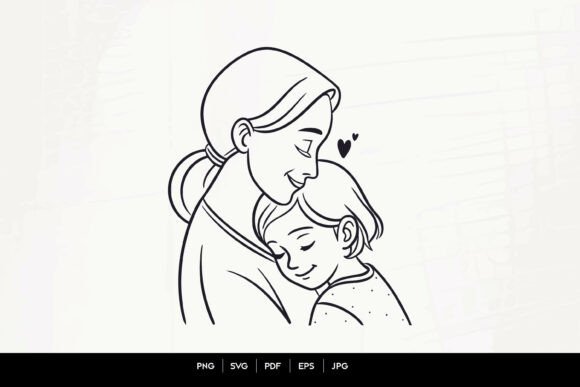
When I first opened the files for the Mother Child Hug – Tender Line Art, my immediate thought was about emotional resonance. In the world of professional branding, especially for the handmade and boutique sectors, clients aren't just buying a logo or a sticker; they are buying a feeling. This specific graphic design asset captures the essence of the maternal bond with a delicacy that is often hard to find in stock libraries. The lines are continuous and fluid, avoiding the jagged edges or overly complex shading that can clutter a clean layout. For a recent project involving a local boutique specializing in organic baby wear, this illustration became the cornerstone of our visual identity strategy.
Setting the Mood for Handmade Business Branding
The primary strength of this illustration lies in its versatility regarding mood. It strikes a perfect balance between modern minimalism and warm, traditional sentimentality. When working with small business branding, particularly in the Crafts category, the goal is often to evoke trust and tenderness without appearing dated. The Mother Child Hug – Tender Line Art achieves this through its open negative space and gentle curves. It suggests unconditional love and bonding without being overly literal or cheesy.
In our client's case, we needed a visual that would work across various touchpoints, from hang tags on clothing to social media graphics on Instagram. The line weight is consistent enough to remain legible even when scaled down for a favicon or a small product label, yet detailed enough to hold attention as a hero graphic on a website landing page. This duality makes it an invaluable tool for designers who need to maintain brand consistency across different mediums.
Practical Applications in Commercial Design
From a technical standpoint, receiving a full suite of file formats—SVG, PNG, EPS, PDF, and JPG—is a significant advantage. Too often, designers receive a single raster file that limits scalability. With the vector formats (SVG, EPS, PDF) included in this bundle, I was able to manipulate the stroke width and color directly within Adobe Illustrator to match the client's specific palette.
Here is how this asset performs in real-world scenarios:
- Packaging Design: The clean lines print beautifully on kraft paper and textured cardstock, making it ideal for eco-friendly packaging where ink coverage needs to be minimal.
- T-Shirt Design and Sublimation: For print-on-demand sellers, the high-resolution PNG with transparency ensures crisp edges on dark fabrics, while the SVG allows for easy separation if using heat transfer vinyl with a Cricut or Silhouette machine.
- Digital Products: The image serves as an excellent focal point for printable wall art or digital planners sold on Etsy, appealing to customers looking for nursery decor.
- Social Media Graphics: When placed over soft, pastel backgrounds in Canva templates, it drives high engagement for posts related to Mother's Day campaigns or parenting blogs.
Strategic Placement and Visual Hierarchy
While the Mother Child Hug – Tender Line Art is robust, knowing where to place it is crucial for maintaining visual hierarchy. It works best in large layout areas where it can breathe, such as the center of a poster, the front of a greeting card, or as a watermark on blog visuals. In these contexts, it acts as a decorative accent that reinforces the theme of family love and connection.
However, caution is required when integrating this into crowded layouts. Because line art relies on the contrast between the stroke and the background, placing it over busy patterns or low-contrast images can cause it to disappear. For minimalist branding projects, it is essential to ensure there is ample white space around the illustration. If used in a complex corporate annual report or a data-heavy infographic, it might feel too soft and could distract from the professional tone required. It is best reserved for projects where emotional appeal and audience engagement are the primary goals.
Technical Review and Designer Notes
Before finalizing any asset for a client, I run a series of practical tests. Here is my checklist for the Mother Child Hug – Tender Line Art:
- Contrast Testing: Always preview the design in pure black and pure white. While the default is likely black, reversing it to white on a dark navy or forest green background can create a stunning, premium look for packaging.
- Scalability Check: Zoom out to 10% size. Does the hug still look like a hug, or do the lines merge? This asset holds up well, but for very small applications like embroidery patches, you may need to simplify the path slightly.
- Font Pairing: This illustration pairs exceptionally well with script fonts and handwritten fonts that mimic personal notes. It also complements clean sans-serif fonts for a more modern, editorial design look. Avoid heavy display fonts that might overpower the delicate nature of the line work.
- File Inspection: Open the SVG and EPS files to ensure all paths are closed and there are no stray anchor points. This prevents issues during the cutting process for sticker design or vinyl applications.
- Licensing Verification: Always confirm the commercial license terms. For client work, ensuring you have the right to use the graphic design asset in merchandise for resale is non-negotiable.
Final Verdict for Creative Professionals
The Mother Child Hug – Tender Line Art is more than just a clipart image; it is a strategic component for building a cohesive brand story. Whether you are a marketer launching a new line of maternal health products, a content creator designing Pinterest pins, or a crafter selling handmade goods, this asset provides the emotional hook necessary to connect with your audience. Its ability to translate seamlessly from a digital screen to a physical product mockup makes it a reliable choice for diverse creative projects. By understanding its strengths in evoking warmth and its limitations in complex environments, designers can leverage this illustration to create polished, professional, and deeply resonant visual experiences.